- edited by
- Matilde Tassinari
- copy edited by
- Griffin Martell
- editorial assistant
- Zoey Chapman
Can an outfit be persuasive? This article explores how shared aesthetic styles – from subcultures to online communities – can strengthen group identity and subtly influence which ideas feel natural and legitimate. In certain contexts, belonging may precede persuasion and contribute to polarization.
Radicalization is often viewed as a change driven by arguments and propaganda. Yet commitment to extreme ideas does not always arise from rational analysis. People may first develop identification with a group, that is, a sense that the group is part of who they are [1], and only later examine its ideological position.
From this perspective, style is not superficial. Taste and clothing function as markers of distinction and belonging [2]. When these signs are shared and repeatedly recognized within a social environment, they can foster collective identities and forms of group belonging. Subcultures represent a clear example of this process, generating belonging through shared symbolic and aesthetic codes that may oppose mainstream norms, without necessarily adopting an explicitly countercultural or political program [3]. These codes establish mutual recognition between members of a given subcultural group [3].

Style as a social identity signal
One example of how style can function to signal how one identifies with a group can be observed in the early punk scene: leather jackets, pins, and colored mohawks function as visible signs of recognition among group members and opposition to mainstream culture. Those who shared the codes could identify one another immediately; those unfamiliar with them remained outside. The example shows how style worked in physical communities before similar mechanisms became faster and more visible online.
Style functions as a visual language through which belonging and difference become recognizable [3]. It activates shared codes that allow others to position a person within a particular social space. Through recurring combinations of things like clothing, hairstyles, or accessories, groups draw boundaries and establish criteria of legitimacy. Members must not only belong but embody the group's aesthetic acceptably [2].
More recent research suggests that, despite the transformation of traditional subcultures, aesthetics remain central to identity formation. Even in more fluid and hybrid contexts, style continues to influence how collective belonging is expressed and recognized [4].
In online contexts, aesthetic codes circulate within networked publics – publics restructured by digital technologies, where content persists, can be replicated, and may reach large audiences [5]. The underlying psychological mechanisms remain largely the same. Like in face-to-face communities, aesthetic signals support belonging, identification, internalization of norms, and identity signaling. In other words, online and face-to-face communities are not too different. What changes online is speed, scale, persistence, and algorithmic amplification. As a result, digital cultures foster micro-publics: small audiences and communities that gather around semiotic patterns – repeated images, slogans, hashtags, and visual styles – that make identity alignment recognizable [6]. On visually driven platforms such as TikTok or Instagram, recommendation systems – the algorithmic systems that select and rank what users see – can repeatedly expose them to similar videos, styles, sounds, and slogans [7]. As this repeated exposure narrows what becomes visible, users increasingly encounter the same aesthetic codes, along with certain opinions and emotional tones. This creates what are commonly called echo chambers: environments in which similar content is continuously reinforced while alternative perspectives become less visible [8].
From visibility to group cohesion
At first, aesthetics enables mutual recognition among members of a particular social group, but over time, they also create a shared idea of who belongs. Through recurring symbols and codes, an implicit model of the group’s typical member, the “prototype,” gradually emerges: a set of traits, attitudes, emotional dispositions, and behaviors perceived as appropriate.
As this shared image becomes more established, the group increasingly appears as a unified whole. Social psychology refers to this perception of a group as coherent and bounded as entitativity [9].
Entitativity has important psychological consequences. When a group appears coherent, it reduces ambiguity and provides a sense of certainty [9]. Because belonging is a fundamental human need, groups become especially attractive when they provide clear boundaries and roles. That is why, for instance, people suffering from personal uncertainty or threats to self-relevance may be drawn to such groups [10]. Identifying with them provides not only belonging but also a sense of orientation, helping define what feels appropriate to think, feel, and do.
In certain situations where social identity becomes important, they tend to align themselves with what is perceived as typical of the group [10]. This “prototype” functions as a compass: it indicates which attitudes and behaviors are appropriate. Group members are not coerced into conformity, instead they all adjust to the same idealized prototypical group member.
In this sense, shared aesthetics can contribute to making the group psychologically meaningful. If symbolic coherence strengthens entitativity, and entitativity makes the group a more attractive and reliable source of identification, then belonging can offer stability and orientation: the group begins to provide criteria for interpreting reality. As this shared identity manifests through common symbols and styles, group identity can develop into a collective identity – a shared sense of what the group stands for, who belongs, and who remains outside.

Norms, conformity, and polarization
Social norms indicate what is considered normal and appropriate. They are not explicit rules, but an expectation for people to behave in the same way. When everyone takes for granted that things are done a certain way, the norm stabilizes and tends to persist over time [11].
Following a norm also signals belonging. If an opinion becomes the shared standard, expressing it signals loyalty, while failing to do so may create ambiguity about group alignment. Norms do not only regulate behavior, they also define who is part of the group and who is not [10]. When different groups develop different norms – for example, on political or moral issues – the distance between them no longer concerns merely divergent ideas, but different ways of defining what is right, acceptable, or legitimate. It is at this point that polarization emerges: When discussing issues mainly with like-minded others, people shift toward and identify more with extreme shared positions [12], which become markers of belonging [13]. Thus, defending an opinion becomes defending the group.
Under these conditions, psychological motivations come into play that reinforce rigidity. Individuals tend to protect their group’s convictions, especially when they perceive threat or conflict [14]. As a result, what was initially a difference in perspective may turn into a strong disagreement.
This is why group norms can lead to polarization: As different groups increasingly organize around their respective norms, their differences can harden into strong ideological opposition [11].
When this happens, polarization may develop into radicalization, a process through which identification with a group can become tied to more extreme commitments [15]. Radicalization can take non-violent forms, marked by rigid, oppositional beliefs and resistance to dialogue, or violent forms, characterized by the acceptance, justification, or use of violence. It is important to stress that radicalization does not necessarily result in violence.
When identity becomes moral
Some opinions stop feeling like preferences and become questions of right and wrong. Psychologists call this moral conviction: a belief that feels unquestionable and difficult to challenge — it feels inherently correct, not like just one legitimate preference among many [16].
When a belief is moralized in this way, disagreements tend to be interpreted in absolute terms. Individuals perceive their positions as objectively correct, meaning they are less willing to compromise and show greater intolerance toward decisions or policies that contradict them [16].
When something considered morally right becomes an integral part of group identity, questioning it means challenging the group itself. Under such conditions, individuals tend to accept evidence that aligns with their group's values whiler ejecting dissonant evidence, especially evidence questioning the group’s fundamental moral values [14]. Similarly, if a piece of information appears to challenge the values that define the group, it is examined with greater suspicion or reinterpreted; if it confirms them, it is more readily accepted. In this way, evidence is not selected for its accuracy, but for how well it protects group identity.
Once trust is established within the group, persuasion no longer depends only on the validity of an argument. It also operates at an earlier, more implicit level, before arguments are consciously evaluated. Specifically, aesthetic alignment influences who appears trustworthy, which messages feel legitimate, and which interpretations feel emotionally congruent with the group. When a message arrives in a fashion style or tone of voice that you identify with, it is perceived as coming from within the group – from a source that already feels trustworthy – which makes it easier to accept and defend. Leaders and influencers often rely on this dynamic. By reflecting the group's aesthetic and emotional tone, they are perceived as insiders rather than outsiders trying to persuade.
Over time, repeated exposure to these shared messages can strengthen certain convictions. When such convictions are perceived as morally grounded, they are also expected to be consistent with one another and to offer a broader explanation of reality. Ideology organizes convictions into a coherent worldview. An ideology links principles, interprets conflicts, and indicates a direction for action [15].
The punk example helps clarify how a group ideology is created. In Britain, some parts of the punk and skinhead music milieu became connected to far-right organizations through Rock Against Communism and related white-power music networks [17]. In that context, music, style, and symbols were no longer only forms of subcultural expression, but became increasingly intertwined with an explicit ideological agenda. What had begun as cultural opposition could evolve into organized political activism.
Contemporary digital spaces affect these dynamics in new ways. Fast-moving online aesthetics, from micro-trends to niche cores, often borrow the visual language of historical subcultures, such as punk, while being rapidly amplified by platform algorithms [6], [7]. However, these similarities should not be overstated. Many niche cores create the impression of identity depth without developing a stable ideology, collective memory, lasting commitment, or coherent social structure. In these cases, aesthetics may signal participation in a rapidly shifting visual trend more than long-term collective belonging to a coherent group with its own values and beliefs. Other online styles, however, can become tied to political or moral claims, making group boundaries more rigid and oppositional. In these environments, echo chambers are more likely to emerge [8]. By contrast, they weaken when people encounter diverse perspectives and spaces where belonging does not depend on looking, thinking, or feeling the same.
In summary, persuasion does not rely only on arguments. It can also occur through signals that define who belongs and with whom to stand. When aesthetics contribute to stabilizing identities, norms, and boundaries, it also makes certain convictions easier to adopt, defend, and connect into a broader worldview. An outfit may not be more persuasive than a speech, but it can influence how that speech will be heard: If belonging precedes persuasion, alignment may begin with aesthetics.
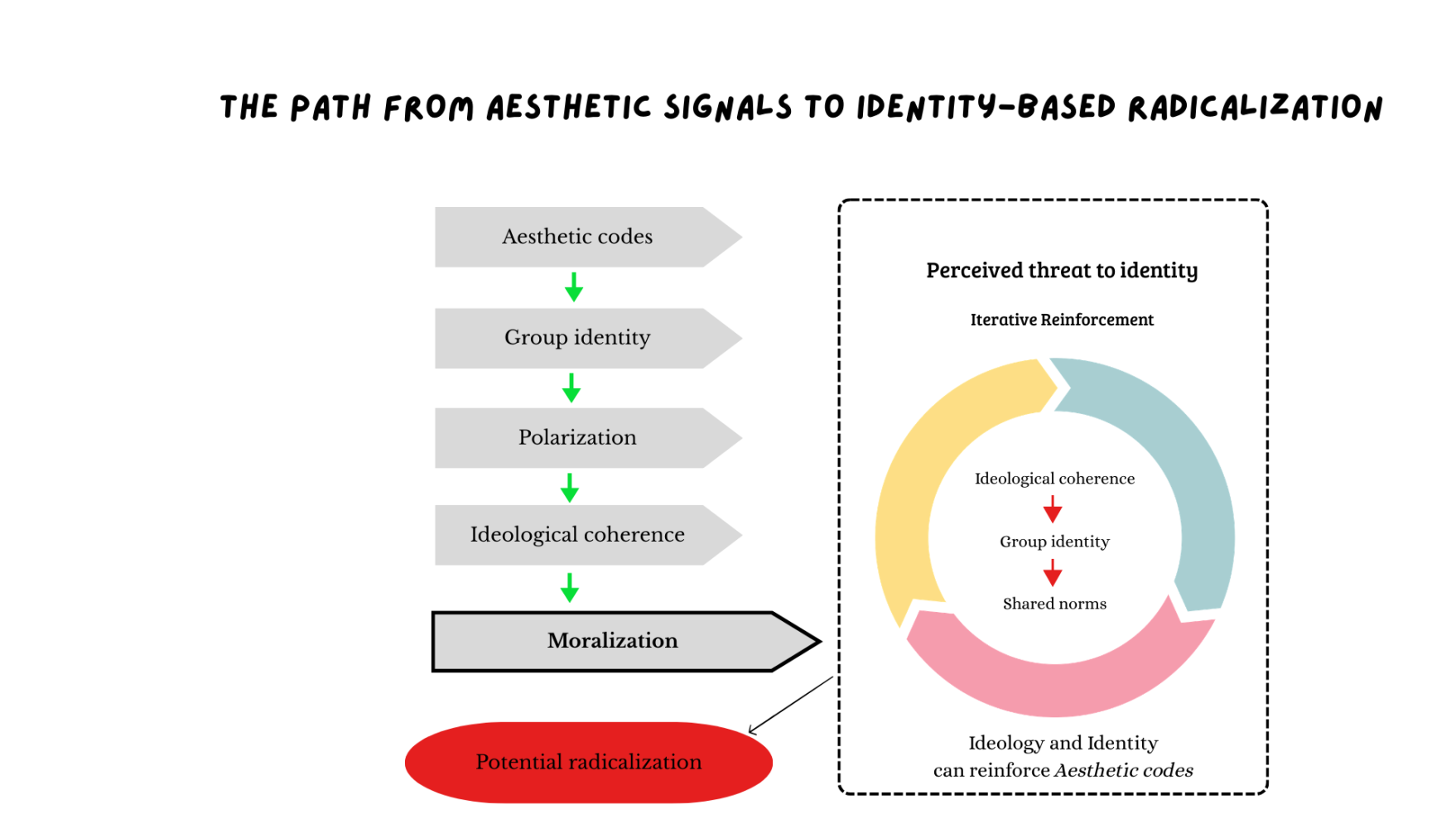
This figure summarizes the proposed pathway from aesthetic signals to identity-based radicalization. Aesthetic codes can make group identity visible and recognizable. Over time, shared identity may contribute to polarization, especially when group boundaries become more rigid. When group positions acquire moral significance, they may become moralized and later organized into a more coherent ideology. Under conditions of perceived threat to identity, this process can become circular: Ideology, group identity, and shared norms reinforce one another and, in turn, strengthen the aesthetic codes through which belonging is recognized. The figure does not suggest that radicalization is inevitable, but illustrates how aesthetic, identity-based, moral, and ideological processes may increase its risk in specific contexts.
Key takeaways
1) Aesthetic codes contribute to stabilizing group norms and models of belonging.
2) In digital contexts, visibility, repetition, and recommendation systems reinforce symbolic coherence.
3) When norms and convictions become central to collective identity, they may gradually acquire moral significance.
4) Radicalization can be non-violent or violent; in both cases, identity and belonging can help explain how convictions become more rigid.
[1] H. Tajfel and J. C. Turner, “An integrative theory of intergroup conflict,” in The social psychology of intergroup relations, W. G. Austin and S. Worchel, Eds. Monterey, CA, USA: Brooks/Cole, 1979, pp. 33–47.
[2] P. Bourdieu, Distinction: A Social Critique of the Judgment of Taste. London, U.K.: Routledge & Kegan Paul, 1984.
[3] D. Hebdige, Subculture: The Meaning of Style. London, U.K.: Routledge, 1979.
[4] M. Sklar, J. Strübel, K. Freiberg, and S. Elhabbassi, “Beyond subculture the meaning of style: Chronicling directions of scholarship on dress since Hebdige and Muggleton,” Fashion Theory, vol. 26, no. 6, pp. 715–735, 2022, doi: 10.1080/1362704X.2021.1954834.
[5] D. Boyd, “Social network sites as networked publics: Affordances, dynamics, and implications,” in A Networked Self, Z. Papacharissi, Ed. New York, NY, USA: Routledge, 2010, pp. 47–66, doi: 10.4324/9780203876527-8.
[6] I. Maly, “New right metapolitics and the algorithmic activism of Schild & Vrienden,” Social Media + Society, vol. 5, no. 2, 2019, doi: 10.1177/2056305119856700.
[7] M. Boeker and A. Urman, “An empirical investigation of personalization factors on TikTok,” in Proceedings of the ACM Web Conference 2022 (WWW ’22), Virtual Event, Lyon, France, Apr. 2022, pp. 2298–2309, doi: 10.1145/3485447.3512102.
[8] M. Cinelli, G. De Francisci Morales, A. Galeazzi, W. Quattrociocchi, and M. Starnini, “The echo chamber effect on social media,” Proceedings of the National Academy of Sciences, vol. 118, no. 9, p. e2023301118, 2021, doi: 10.1073/pnas.2023301118.
[9] M. A. Hogg, D. K. Sherman, J. Dierselhuis, A. T. Maitner, and G. Moffitt, “Uncertainty, entitativity, and group identification,” Journal of Experimental Social Psychology, vol. 43, no. 1, pp. 135–142, 2007, doi: 10.1016/j.jesp.2005.12.008.
[10] M. A. Hogg, “From uncertainty to extremism: Social categorization and identity processes,” Current Directions in Psychological Science, vol. 23, no. 5, pp. 338–342, 2014, doi: 10.1177/0963721414540168.
[11] D. Abrams, M. Wetherell, S. Cochrane, M. A. Hogg, and J. C. Turner, “Knowing what to think by knowing who you are: Self-categorization and the nature of norm formation, conformity and group polarization,” British Journal of Social Psychology, vol. 29, pp. 97–119, 1990, doi: 10.1111/j.2044-8309.1990.tb00892.x.
[12] C. R. Sunstein, “The law of group polarization,” Journal of Political Philosophy, vol. 10, pp. 175–195, 2002, doi: 10.1111/1467-9760.00148.
[13] S. Iyengar, Y. Lelkes, M. Levendusky, N. Malhotra, and S. J. Westwood, “The origins and consequences of affective polarization in the United States,” Annual Review of Political Science, vol. 22, pp. 129–146, 2019, doi: 10.1146/annurev-polisci-051117-073034.
[14] D. M. Kahan, “Ideology, motivated reasoning, and cognitive reflection,” Judgment and Decision Making, vol. 8, no. 4, pp. 407–424, 2013, doi: 10.1017/S1930297500005271.
[15] A. W. Kruglanski, M. J. Gelfand, J. J. Bélanger, A. Sheveland, M. Hetiarachchi, and R. Gunaratna, “The psychology of radicalization and deradicalization: How significance quest impacts violent extremism,” Political Psychology, vol. 35, pp. 69–93, 2014, doi: 10.1111/pops.12163.
[16] L. J. Skitka, “The psychology of moral conviction,” Social and Personality Psychology Compass, vol. 4, no. 4, pp. 267–281, 2010, doi: 10.1111/j.1751-9004.2010.00254.x.
[17] R. Shaffer, “The soundtrack of neo-fascism: Youth and music in the National Front,” Patterns of Prejudice, vol. 47, no. 4–5, pp. 458–482, 2013, doi: 10.1080/0031322X.2013.842289.
Image 1. Photo by Nick Fewings on Unsplash
Image 2. Photo by Nik on Unsplash
Image 3. Photo by Nick Fewings on Unsplash
Image 4. Created with Canva
Reviewers: Rosmery-Ann Boegeholz Castillo and an anonymous reviewer.
D'Elia, P. (2026). Can an outfit be more persuasive than a speech? Aesthetic signals, identity, and the path to radicalization. In-Mind, 2026(11). https://www.in-mind.org/article/can-an-outfit-be-more-persuasive-than-a-speech-aesthetic-signals-identity-and-the-path-to