- editorial assistant
- Nathalie Claus,
- Elena Benini

Classifying side effects
Imagine you have a headache and reach for a painkiller. However, before you swallow the pill, you may want to consider its possible side effects (e.g., dry mouth or dizziness). It is important to know about these risks so that you can make an informed decision about whether the treatment is right for you. This applies to any treatment, whether it involves simply taking a pill or undergoing a more complex intervention such as psychotherapy. Yet, many people remain unaware that psychotherapy can produce side effects.
“Side effects” is a complex umbrella term. It refers to experiences that may occur during or after psychological treatment that do not belong to the treatment’s intended goals [5]. Side effects can be either positive or negative. For instance, a patient may experience improved interpersonal relationships (positive side effect) or worsening of symptoms (negative side effect). This article focuses on the negative side effects of psychotherapy and the potential risks they pose to both patients and therapists. This knowledge is especially crucial to a patient’s ability to provide informed consent.
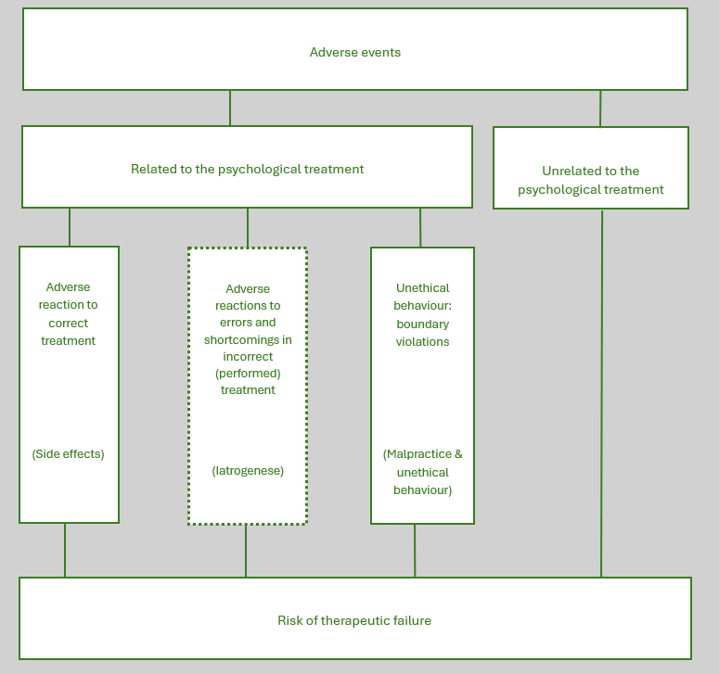
Not every adverse event that occurs during psychotherapy is a result of psychotherapy itself. Image 2 helps to distinguish between the different types of adverse events that may occur during psychotherapy [5]. Understanding these differences is important because they have different causes and require different responses. First, some adverse events may occur during psychotherapy that are not caused by therapy itself, such as the sudden loss of a loved one. Although these types of events can have a major effect on the well-being of a patient, they are not caused by therapeutic treatment. Other adverse events are related to treatment and can be identified in instances where psychotherapy is delivered correctly or incorrectly, in addition to violations of professional standards [5, 6, 7]. When we speak of a side effect in the strict scientific sense, this means an unwanted reaction to a treatment that has been delivered correctly, as in the case of exposure therapy. Exposure therapy helps people gradually face feared situations or objects. When someone intentionally avoids such a feared situation for a long time, sudden exposure to it will initially increase stress and anxiety. Yet this is exposure therapy working as intended. Ultimately, the experience will help the patient learn to cope with and manage their fear. By contrast, some adverse events occur when treatment is delivered incorrectly. For example, when therapists ask suggestive questions during hypnosis, they may lead the patient to form false memories [7]. Finally, other adverse events involve the violations of professional standards such as inadequate file management and unethical behavior (e.g., verbal or sexual abuse). This classification makes it clear that the term side effects should not be used for every adverse event during psychotherapy.
However, it should be noted that during psychotherapy, errors and shortcomings may arise. In this situation, the focus should be on human error, not issues with the procedures of the treatment itself. For example, errors might involve misjudging a patient’s capacity to cope, while shortcomings could include a therapist arriving late to a therapy session.
Nevertheless, it will often be difficult to directly link these adverse experiences and events to treatment, or where it is unclear whether they could have been prevented. Stress, for example, may increase as a result of discussing emotional topics in therapy sessions, but it may also arise due to external circumstances, such as changes in the patient’s family situation. Furthermore, deciding how to classify the patient’s experiences is not always straightforward. For instance, different therapists may have different perspectives on a patient experiencing a panic attack during a therapeutic exercise. One might ask whether this panic attack was preventable and whether it should have been prevented? The appropriate response will depend on how both the therapist and the patient understand the event, including whether they see it as part of the treatment process or as an experience that is not clearly caused by the treatment. Although it can be helpful to categorize an adverse event as being an intended part of the treatment or not, this does not resolve the full complexity of side effects. Beyond the challenge of classifying the concept altogether, the current abundance of synonyms, such as negative experiences or adverse outcomes, makes the issue even more complicated [8]. In short, side effects do occur [1, 9] and there is considerable confusion for both patients and therapists. To classify side effects, they first need to be recognized, and this, in turn, brings its own challenges.
Recognizing side effects: a blind spot
Recognizing side effects in psychotherapy is difficult, not only because classifying them is complicated, but also due to other factors that contribute to blind spots in recognizing side effects. For example, current clinical training for therapists pays limited attention to the topics of therapeutic side effects or harm [10]. Therapists cannot apply knowledge they do not possess, especially when there is still no consensus on it.
Although greater awareness of side effects among therapists is an important step in the right direction, the process of raising awareness is like lighting a room with dim twilight: it provides some visibility but leaves many shadows where incidents can go unnoticed. Side effects often remain unnoticed because patients may find it very difficult to raise them, as doing so might be perceived as criticism of the therapist’s work or a potential harm to the therapeutic relationship [11].
In addition, both therapists and patients may be subject to biases. For instance, therapists may be overly optimistic about treatment progress (the so-called optimism bias) [12, 13]. In one study, therapists were informed that on average 8% of patients at their clinic experienced worsening symptoms over the course of their treatment. Yet, the therapists’ prediction was that only three out of 550 patients (0.01%) would get worse, much less than the 40 patients (7.3%) whose condition actually ended up worsening [14]. Moreover, only one of those three predicted patients actually experienced worsening symptoms [14]. Of course, therapists cannot predict every outcome, and deterioration may occur only rarely across large groups of patients. This phenomenon is problematic for therapists, however. It suggests that therapists’ optimism bias leads to a diminished sensitivity towards the early warning signs of worsening symptoms making it more likely to miss other more subtle side effects as well.
Yet, patients can also bring their own biases to therapy. This can unintentionally result in a distorted picture of treatment progress or the presence of side effects. Patients may exaggerate the severity of their symptoms to qualify for treatment. [15]. Conversely, they may downplay symptoms, which often occurs towards the end of therapy, to create the impression that they are improving or to please the therapist [16]. Such patterns can lead a therapist to overlook changes in symptoms and signs of potential side effects. For instance, a patient may initially report their symptoms as more severe than they actually are in order to ensure that they receive the treatment they need. Later on, it will be difficult for the therapist to classify any reported symptoms as ongoing exaggeration or as actual deterioration of the patient’s condition. In addition, many patients find it difficult to discuss negative side effects or to express criticism of treatment [17]. This may stem from fear of conflict, loyalty toward the therapist, or difficulty putting their experiences into words [17]. In sum, these biases, together with inaccurate symptom presentation and interpersonal dynamics create blind spots in the patient and therapist’s perceptions of treatment progress, which makes side effects difficult to identify in clinical practice. Ultimately, this underscores the need for external support.
A potential safety net: monitoring side effects
Outcome monitoring may help identify side effects. Today, outcome management practices, such as routine outcome measurement (ROM), are widely used to monitor treatment improvement or deterioration of conditions like depression [18]. However, ROM typically only includes those aspects that are intended treatment outcomes — not unintended side effects. For this reason, different measurement tools are needed. Several measurement instruments have been developed specifically to monitor side effects. These tools go beyond tracking overall treatment progress or symptom improvement/worsening. Such specificity is necessary because side effects can vary in nature. For example, they may be emotional, cognitive, social, and/or physiological [4].
Most instruments designed to assess side effects are completed solely by patients [19, 20]. They differ in the types of side effects they assess, whether they quantify severity, and how they determine the extent to which an effect is related to the treatment. In addition, positive side effects are rarely included. This heterogeneity complicates comparisons across measures and makes it difficult to obtain an integrated picture across the perspectives of patients and therapists.
The Unwanted Events in the view of Patient and Therapist checklist (UE-PT) could help alleviate these issues [21]. The instrument covers multiple domains in which side effects may occur and helps to identify relevant areas of concern. Because both the patient and the therapist complete the UE-PT, the two perspectives can be compared directly. Simultaneous use may also facilitate a dialogue about potential side effects, which can increase awareness for both parties, create room to address ambiguities, and provide useful feedback for treatment [11, 21].
A first randomized study explored the impact of using the UE-PT within the therapeutic relationship [11]. Although the study had limitations, the initial findings are promising. Compared with the beginning of treatment, the group using the UE-PT for systematic monitoring and the discussion of side effects showed an improvement in the therapeutic relationship and a reduction in anxiety symptoms following treatment. One possible explanation for this is that patients feel their concerns are being taken seriously and that the use of such an instrument signals a shared commitment to active collaboration [11]. Reporting side effects thus becomes a joint therapeutic goal rather than a source of tension between therapist and patient. Moreover, the UE-PT may provide signals for timely adjustments to the treatment plan so that further potential harm can be avoided (e.g., changing the treatment intensity) [11, 22]. While further research is needed to clarify the scope and robustness of these effects, these preliminary findings suggest potential benefits for both patients and therapists, as well as for their collaboration if negative effects are monitored during treatment.
Concluding remarks
Psychotherapy remains complex and even when treatment is delivered correctly, side effects and other limitations may occur alongside positive outcomes. Fortunately, scientific attention to this topic has increased in recent years. This is crucial to address questions such as: What is the impact of side effects on therapy outcomes? Are certain therapies associated with particular side effects, and how does the risk of such effects differ across mental health diagnoses? Which side effects are common across types of treatment, and which emerge in specific phases of therapy? By supporting therapists and patients with research-based knowledge and measurement tools, clinical practice can gain a clearer understanding of treatment outcomes and improve detection of unwanted side effects. In this way, the dim twilight grows brighter, the shadows recede, and adverse side effects are less likely to go unnoticed. Perfection in treatment is unattainable but greater attention to side effects and adverse events may help therapists better support patients and improve their overall quality of care.
Bias: An error in one’s thinking process or a distorted perception of reality arising from automatic thought processes that systematically steer decision-making in a particular direction. Also known as cognitive bias.
Exposure: Exposure is a therapeutic technique in which individuals are gradually and systematically confronted with situations, objects, thoughts, or physical sensations that they find distressing or avoid. The goal is to reduce fear and avoidance, promote new learning, and build tolerance through direct experience. Exposure techniques are used in various evidence-based treatments, including those for anxiety disorders, obsessive-compulsive disorder, post-traumatic stress disorder, and certain phobias.
Measurement instrument: A tool used for measurement or observation.
Monitoring: Collecting information for evaluation.
Optimism bias: The tendency to overestimate positive experiences and underestimate negative experiences.
Psychotherapy: Structured, evidence-based treatment for mental disorders and problems.
Randomized study: An intervention study in which the study participants are randomly assigned to an intervention group (experimental group) and a control group.
Routine Outcome Management (ROM): Measuring treatment outcomes using questionnaires that assess symptoms and functioning.
Side effects: Unintended effects that emerge during or after treatment that are not included in the proposed treatment goals.
Therapeutic relationship: The relationship between the patient and the therapist. For example, the degree of agreement between them on therapeutic goals or tasks, and the quality of their interpersonal bond.
[1] R. Klatte, B. Strauss, C. Flückiger, F. Färber, and J. Rosendahl, “Defining and assessing adverse effects and harmful effects in psychotherapy study protocols: A systematic review,” Psychotherapy, vol. 60, no. 1, pp. 130–148, 2023, https://doi.org/10.1037/pst0000359
[2] G. D. Parry, M. J. Crawford, and C. Duggan, “Iatrogenic harm from psychological therapies – time to move on,” The British Journal of Psychiatry, vol. 208, no. 3, pp. 210–212, 2016. https://doi.org/10.1192/bjp.bp.115.163618
[3] B. Strauss, R. Gawlytta, A. Schleu, and D. Frenzl, “Negative effects of psychotherapy: estimating the prevalence in a random national sample,” BJPsych Open, vol. 7, no. 6, 2021. https://doi.org/10.1192/bjo.2021.1025
[4] S. T. L. Houben, “Baat het niet, dan schaadt het niet? Over de negatieve effecten van psychotherapie,” The Inquisitive Mind, no. 1, 2022. https://nl.in-mind.org/article/baat-het-niet-dan-schaadt-het-niet-over-de-negatieve-effecten-van-psychotherapie
[5] M. Linden, “How to define, find, and classify side effects in psychotherapy: From unwanted events to adverse treatment reactions,” Clinical Psychology & Psychotherapy, vol. 20, pp. 286–296, 2013. https://doi.org/10.1002/cpp.1765
[6] P. Herzog, S. Lauff, W. Rief, and E. L. Brakemeier, “Assessing the unwanted: A systematic review of instruments used to assess negative effects of psychotherapy,” Brain and Behaviour, vol. 9, no. 12, 2019. https://doi.org/10.1002/brb3.1447
[7] B. Dandachi-FitzGerald, H. Otgaar, and H. Merckelbach, “When Psychotherapy Fails,” in Toward a Science of Clinical Psychology, C. L. Cobb, S. J. Lynn, and W. O’Donohue, Eds., Cham: Springer International Publishing, 2023, pp. 301–319. https://doi.org/10.1007/978-3-031-14332-8_16
[8] B. C. Batic and D. Hayes, “Exploring harm in psychotherapy: Perspectives of clinicians working with children and young people,” Counselling and Psychotherapy Research, vol. 20, no. 4, pp. 647–656, 2020. https://doi.org/10.1002/capr.12347
[9] M. J. Crawford, L. Thana, L. Farquharson, L. Palmer, E. Hancock, P. Bassett, J. Clarke, and G. D. Parry, “Patient experience of negative effects of psychological treatment: results of a national survey,” The British Journal of Psychiatry, vol. 208, no. 3, pp. 260–265, 2016. https://doi.org/10.1192/bjp.bp.114.162628
[10] S. T. L. Houben, A. C. P. Backus, H. Merckelbach, and B. Dandachi‐FitzGerald, “Exploring the Overlooked: Dutch Clinicians’ Perspectives on Side Effects of Psychological Interventions,” Clinical Psychology & Psychotherapy, vol. 33, no. 1, p. e70209, 2026, https://doi.org/10.1002/cpp.70209
[11] B. Muschalla, J. Müller, A. Grocholewski, and M. Linden, “Effects of talking about side effects versus not talking about side effects on the therapeutic alliance: A controlled clinical trial,” Acta Psychiatrica Scandinavica, vol. 148, no. 2, pp. 208–216, 2023. https://doi.org/10.1111/acps.13543
[12] S. Bystedt, A. Rozental, G. Andersson, J. Boettcher, and P. Carlbring, “Clinicians’ perspectives on negative effects of psychological treatments,” Cognitive Behaviour Therapy, vol. 43, no. 4, pp. 319–331, 2014. https://doi.org/10.1080/16506073.2014.939593
[13] D. Hatfield, L. McCullough, S. H. Frantz, and K. Krieger, “Do we know when our clients get worse? An investigation of therapists’ ability to detect negative client change,” Clinical Psychology & Psychotherapy, vol. 17, no. 1, pp. 25–32, 2010. https://doi.org/10.1002/cpp.656
[14] C. Hannan, M. J. Lambert, C. Harmon, S. L. Nielsen, D. W. Smart, K. Shimokawa, and S. W. Sutton, “A lab test and algorithms for identifying clients at risk for treatment failure,” Journal of Clinical Psychology, vol. 61, no. 2, pp. 155–163, 2005. https://doi.org/10.1002/jclp.20108
[15] G. Punton, A. L. Dodd, and A. McNeill, “‘You’re on the waiting list’: An interpretive phenomenological analysis of young adults’ experiences of waiting lists within mental health services in the UK,” PLoS ONE, vol. 17, no. 3, p. e0265542, 2022, https://doi.org/10.1371/journal.pone.0265542
[16] T. J. G. Tracey, B. E. Wampold, J. W. Lichtenberg, and R. K. Goodyear, “Expertise in psychotherapy: An elusive goal?” American Psychologist, vol. 69, no. 3, pp. 218–229, 2014. https://doi.org/10.1037/a0035099
[17] A. C. M. Li, W. W. S. Mak, and H. Chui, “A qualitative study of service user reports of negative experiences regarding therapist practices,” Journal of Counseling Psychology, 2025. https://doi.org/10.1037/cou0000796
[18] M. Barkham, K. De Jong, J. Delgadillo, and W. Lutz, “Routine outcome monitoring (ROM) and feedback: Research review and recommendations,” Psychotherapy Research, vol. 33, no. 7, pp. 841–855, 2023. https://doi.org/10.1080/10503307.2023.2181114
[19] A. Rozental and T. Řiháček, “How to measure negative effects of psychological interventions,” Current Opinion in Psychology, vol. 65, p. 102084, 2025, https://doi.org/10.1016/j.copsyc.2025.102084
[20] B. Dandachi‐FitzGerald, S. T. L. Houben, N. J. Broers, and H. Merckelbach, “A scale for measuring positive and negative experiences of psychotherapy (PNEP): First psychometric findings of a new instrument for monitoring clients’ experiences,” Clinical Psychology & Psychotherapy, vol. 31, no. 3, 2024. https://doi.org/10.1002/cpp.3014
[21] M. Linden, “Parallel recording of psychotherapy side effects by patient and therapist in routine as well as training therapies by means of the ‘UE-PT scale’,” Psychosoziale und Medizinische Rehabilitation, no. 116, pp. 63–70, 2021.
[22] M. Lambert, “Presidential address: What we have learned from a decade of research aimed at improving psychotherapy outcome in routine care,” Psychotherapy Research, vol. 17, no. 1, pp. 1–14, 2007. https://doi.org/10.1080/10503300601032506
Image 1: Photo via Pexels (https://www.pexels.com/de-de/foto/menschen-stift-frauen-sitzung-5234628/).
Image 2: Created by the authors as an addition to the visualization by Dandachi-FitzGerald et al. [7].
Note: An earlier version of this article has been published in the Dutch version of In-Mind.
Backus, A. C. P., Houben, S. T. L., & Dandachi-FitzGerald, B. (2026). Shedding light on the shadows of psychotherapy – monitoring side effects. In-Mind, 2026(10). https://www.in-mind.org/article/shedding-light-on-the-shadows-of-psychotherapy-monitoring-side-effects