
- edited by
- Chenhao Zhou
- copy edited by
- Griffin Martell
- editorial assistant
- Zoey Chapman
Reviewers: Two anonymous reviewers
Teams today collaborate across screens, time zones, and digital tools, but better technology does not always mean better teamwork. Hybrid meetings, information overload, and workflows supported by artificial intelligence (AI) create new challenges. Drawing on expert insights and psychological research, this article explores which team skills matter most and how teams can build them.
The meeting starts on time, but not everyone is fully engaged. While some team members sit together in a conference room, others may join from home or dial in from different time zones. Messages appear in the chat while someone is speaking, and an AI tool quietly takes notes in the background. By the end of the meeting, decisions are still unclear, and several participants feel exhausted rather than aligned. Scenes like this have become part of everyday work. Teams collaborate more than ever, yet many struggle to stay coordinated and maintain a sense of connection and focus [1]. Understanding which skills help teams work effectively and how those skills can be developed, has become a central question for modern teamwork.
To explore which skills are most relevant for teamwork today and in the near future, we draw on insights from both psychological research and a structured exchange with experts. Around 40 experts from fields ranging from organizational psychology to leadership development and higher education participated in the discussion. Drawing on experience across different sectors, they reflected on the challenges that teams currently face, which new skills are becoming important, and how these skills can best be developed.
Why teamwork feels harder despite better technology
At first glance, teamwork should be easier than ever. Organizations rely on tools such as video calls and shared documents, along with project platforms and instant messaging. People can collaborate from almost anywhere. Yet many teams experience the opposite: They feel more confused, more exhausted, and less clear about responsibilities [2].
One reason is that work is no longer centered in a single place or time. In hybrid settings, some team members sit together in a room while others participate remotely. Important cues, such as eye contact or quick clarifications, are easily lost [3]. Conversations split between spoken discussion and parallel chat messages. What appears to be efficient multitasking frequently results in fragmented attention and missed agreements. In addition, opportunities for informal exchange have become limited. In traditional workplaces, short conversations in hallways or after meetings helped resolve misunderstandings and build trust [4]. In virtual environments, these interactions happen less spontaneously, allowing small issues to persist and sometimes turn into frustration.
A further challenge is information overload. Digital tools make it easy to share updates, but they rarely help teams identify what is most relevant. Messages accumulate while notifications constantly compete for attention, making priorities shift quickly. As a result, team members may remain busy throughout the day while still feeling uncertain about goals or next steps.
Finally, roles and responsibilities are often less clear than they initially appear. When tasks are distributed across different tools and platforms or spread over time zones, it becomes harder to identify who is responsible for specific decisions. As a result, teams may end up repeating work or becoming frustrated, especially under time pressure [2].
Taken together, these factors help explain why teamwork can feel more demanding today, despite increasingly advanced technology. The challenge is not a lack of tools, but the growing need for skills that help teams work in alignment, stay connected, and maintain focus under changing work environments [5].

How teams can work well today
These days, collaboration is shaped by information overload and hybrid work, and responsibilities often remain unclear. In these situations, the solution is rarely another digital tool. Instead, both psychological research and expert perspectives point to a small set of core skills that make teamwork effective in different settings.
At the center of effective teamwork is clear communication. This involves more than simply sharing information. Teams perform more effectively when members regularly check that they share the same understanding of what the team is trying to achieve, which decisions have been made, and what should happen next [6]. In practice, this may involve briefly summarizing key outcomes at the end of a meeting or explicitly clarifying responsibilities. For example, a hybrid team might briefly document decisions and next steps in a shared chat before signing off, ensuring that all members leave with the same understanding. These small habits can prevent misunderstandings from accumulating over time.
Closely connected to communication is coordination. Shared structures help teams align their efforts, especially when members do not work side by side. When roles are clearly defined and decision-making processes remain transparent, teams are generally better able to coordinate their work and avoid unnecessary friction [6]. Without effective coordination, even highly motivated team members may end up working toward different priorities. For instance, parallel discussions across different platforms may create conflicting assumptions about responsibilities.
Trust is another essential component of effective teamwork. Collaboration becomes smoother when team members feel confident that others will follow through on commitments and speak up when problems emerge [7]. Trust also facilitates the early discussion of mistakes or disagreements before they escalate. In many cases, trust develops through everyday behaviors such reliably following through on commitments and showing genuine attention to others.
Closely related to trust is psychological safety, the shared perception that feeling comfortable asking questions or speaking up about uncertainty and concerns is acceptable within the team. In psychologically safe environments, individuals are more likely to exchange information more openly and are better able to learn from setbacks [4]. This becomes particularly important in complex or rapidly changing situations.
Finally, effective teamwork also depends on self-management at both the individual and team level [8]. Team members must manage their workload and personal boundaries, particularly in digital work environments where professional and personal life can easily overlap. Teams that openly discuss how much work people can realistically handle and when they are available are generally better equipped to sustain performance without increasing the risk of burnout.
Together, these skills form the foundation of effective teamwork today. They help teams remain aligned and resilient while maintaining a sense of connection, even in distributed work settings that are often fast-paced and uncertain.
What teams will need to stay effective in the future
While the core foundations of teamwork remain stable, many organizations are already facing conditions that make these skills more difficult to apply. Looking ahead, effective collaboration will increasingly depend on how well teams adapt to the growing complexity of digital work environments and constant change.
One important capability is digital literacy [2]. This does not mean that every team member must master every new tool. Instead, teams need a shared understanding of how digital technologies influence the way teams communicate, coordinate their work, and manage workload. It is important that teams know which actions are appropriate in different situations: sending a brief message, holding a meeting, or drawing on automation. This helps ensure that technology supports collaboration rather than complicating it.
In diverse and global work environments, intercultural awareness and empathy will continue to gain importance. Differences in how people communicate, what they expect from collaboration, and which norms shape their work interactions can easily lead to misunderstandings, especially in virtual settings [4]. Teams that openly acknowledge these differences and remain curious about others’ perspectives are generally better able to collaborate across boundaries.
Finally, resilience will become an increasingly important team capability. It can be exhausting to work under conditions of constant change and continuous information flow while also remaining permanently available. Teams that openly discuss how much work people can realistically handle and where personal limits should be respected are more likely to sustain performance over time. In this context, resilience should not be understood solely as an individual characteristic, but also as a collective capacity, shaped by how team members support one another during demanding periods [5].
Together, these future-oriented skills help teams remain effective in rapidly changing work environments shaped by digital technologies and uncertainty. They build on the foundations of effective teamwork today while preparing organizations and employees for future challenges.
How teams can develop these skills
Knowing which skills matter is only the first step. The more difficult question is how to develop these skills in everyday work. Research on team learning suggests that skill development is most effective when tied to real workplace challenges rather than isolated in formal training sessions [9].
One effective approach involves coaching and mentoring. These formats create space for reflection, especially when teams operate under uncertainty or pressure. Coaches or mentors can help teams step back from day-to-day work, reflect on recurring interaction patterns, and explore alternative ways of collaborating [10]. This is particularly valuable when goals remain unclear and maintaining alignment over time is difficult.
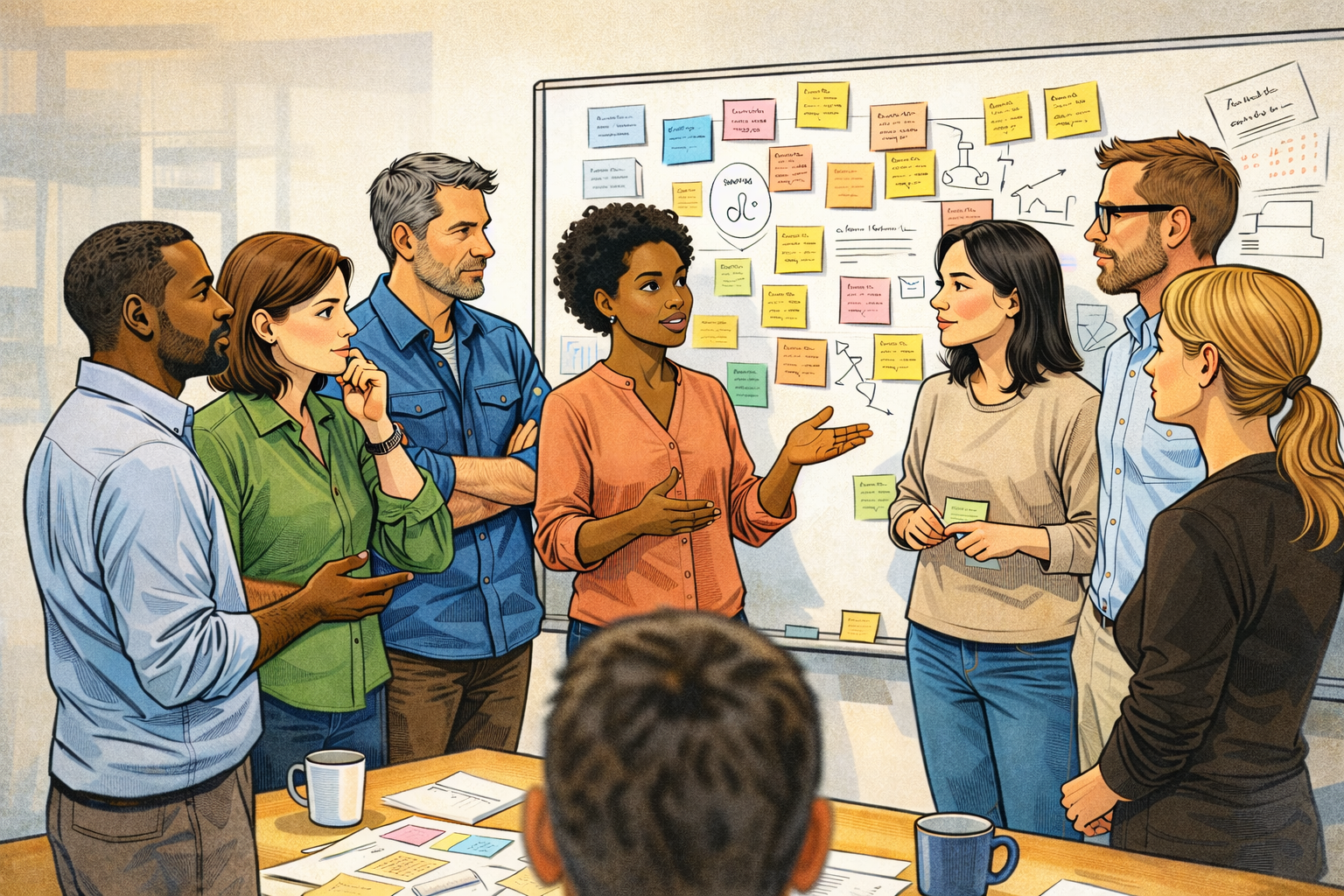
Interactive workshops represent another valuable learning format. Unlike lecture-based training, workshops allow participants to actively work on how they collaborate and define responsibilities [9]. For example, an international team working under time pressure while also dealing with cultural differences might use this kind of workshop to get on the same page about expectations and decision rules. When teams develop these agreements together, they are more likely to follow them in everyday work.
In virtual and hybrid settings, regular reflection sessions become especially important. In teams working across locations or time zones, these check-ins can help identify and resolve misunderstandings before they develop into frustration. Short check-ins or retrospectives provide opportunities to discuss what is functioning well and where adjustments are needed. In technology-driven work environments, characterized by high information load and unclear responsibilities, such exchanges can help teams regain focus. Without these opportunities, misunderstandings may accumulate unnoticed [9]. Reflection does not need to be time-consuming – even brief conversations can strengthen alignment and trust over time.
Simulations and role plays can also prepare teams for demanding or ambiguous situations. By practicing responses to stressful situations such as conflicts and sudden changes in a safe environment, teams can build confidence and improve coordination before similar situations arise in practice [11]. These formats are particularly useful when rapid decision-making under stress is required.
Finally, peer learning and digital learning tools can support continuous development. Exchanging experiences with other teams helps normalize challenges and spread practical solutions [10]. E-learning modules can also help develop shared knowledge about how teams use tools, organize workflows, and collaborate in practice, especially in geographically distributed teams.
No single learning format works equally well for every team or situation. Most teams benefit from a balanced approach that combines opportunities for reflection coupled with open dialogue and practical experience. Over time, the goal is not only to strengthen specific skills, but also to establish continuous learning as an integral part of teamwork [9].
Looking ahead: technology, AI, and the human side of teamwork
Digital technologies will continue to shape how teams collaborate. Teams increasingly rely on virtual collaboration and automation, while AI is becoming embedded in everyday work processes, and their influence is likely to increase further [12]. These developments create new opportunities, but they also raise important questions about how to maintain effective collaboration while remaining transparent and socially connected. For example, consulted experts referred to applications, such as AI-supported meeting summaries or systems, as tools that may help teams process information and organize tasks more efficiently. However, they also emphasized that these technologies may introduce new challenges, particularly when information is incomplete or misleading, making it difficult for teams to evaluate properly. These considerations highlight that technology cannot replace the relational dimensions of teamwork. Trust and mutual support, together with a shared understanding of collaboration remain fundamentally human processes [4], [7].
As collaboration becomes increasingly technology-mediated, organizations and teams will need to make more deliberate decisions about how digital tools are used. This includes determining when automation supports collaboration and when it creates unnecessary complexity, as well as ensuring transparency regarding how data are collected and applied. Questions related to fairness and privacy, and who controls these systems, become especially relevant when algorithms begin to influence how work is assigned or evaluated [12].
Looking ahead, the most effective teams are unlikely to be those that avoid difficulties altogether. Instead, they will be teams that learn from friction, approach communication as an ongoing process, and adapt collectively to change. Such teams create spaces for dialogue, regularly reflect on their ways of working, and remain attentive to both performance and well-being. For organizations, this means investing not only in technical infrastructure, but also in the human foundations of collaboration. Organizations therefore need to create time for reflection, encourage continuous learning, and provide supportive leadership. For individuals, it requires curiosity and flexibility to adapt how they use technology and collaborate with others.
Teamwork is not a fixed set of behaviors but a dynamic process that evolves within different contexts [6]. As work environments continue to change, teams that successfully combine technological possibilities with human skills will be better prepared for future challenges.
Bibliography
[1] Microsoft. „The Next Great Disruption Is Hybrid Work—Are We Ready?“ Accessed: Jan. 8, 2026 [Online.] Available: https://www.microsoft.com/en-us/worklab/work-trend-index/hybrid-work
[2] Handke, L., Costa, P., & O’Neill, T. A. “Virtual teams: taking stock and moving forward.” Small Group Research 55(5), 671–679, 2024, doi:10.1177/10464964241274129.
[3] Handke, L., Klonek, F. E., Parker, S. K., & Kauffeld, S. “Interactive effects of team virtuality and work design on team functioning.” Small Group Research 51(1), 3–47, 2019, doi:10.1177/1046496419863490.
[4] Salas, E., Reyes, D. L., & McDaniel, S. H. “The science of teamwork: Progress, reflections, and the road ahead.” American Psychologist 73(4), 593–600, 2018, doi:10.1037/amp0000334.
[5] Sanford, N., Lounsbury, O., Reedy, G., Rafferty, D. A. M., & Anderson, J. E. “Team adaptive capacity and adaptation in dynamic environments: A scoping review of the literature.” Human Factors in Healthcare 6, 100089, 2024, doi:10.1016/j.hfh.2024.100089.
[6] Driskell, J. E., Salas, E., & Driskell, T. “Foundations of teamwork and collaboration.” American Psychologist 73(4), 334–348, 2018, doi:10.1037/amp0000241.
[7] Breuer, C., Hüffmeier, J., & Hertel, G. “Does trust matter more in virtual teams? A meta-analysis of trust and team effectiveness considering virtuality and documentation as moderators.” Journal of Applied Psychology 101(8), 1151–1177, 2016, doi:10.1037/apl0000113.
[8] Lacerenza, C. N., Marlow, S. L., Tannenbaum, S. I., & Salas, E. “Team development interventions: Evidence-based approaches for improving teamwork.” American Psychologist 73(4), 517–531, 2018, doi:10.1037/amp0000295.
[9] McEwan, D., Ruissen, G. R., Eys, M. A., Zumbo, B. D., & Beauchamp, M. R. “The Effectiveness of Teamwork Training on Teamwork Behaviors and Team Performance: A Systematic Review and Meta-Analysis of Controlled Interventions.” PLoS ONE 12(1), e0169604, 2017, doi:10.1371/journal.pone.0169604.
[10] Kim, T., Liden, R. C., Liu, Z., & Wu, B. “The interplay of leader–member exchange and peer mentoring in teams on team performance via team potency.” Journal of Organizational Behavior 43(5), 2022, doi:10.1002/job.2590.
[11] Marlow, S. L., Salas, E., Landon, L. B., & Presnell, B. “Eliciting teamwork with game attributes: A systematic review and research agenda.” Computers in Human Behavior 55, 413–423, 2015, doi:10.1016/j.chb.2015.09.028.
[12] Seeber, I., Bittner, E., Briggs, R. O., de Vreede, T., de Vreede, G.-J., Elkins, A., Maier, R., Merz, A. B., Oeste-Reiß, S., Randrup, N., Schwabe, G., & Söllner, M. “Machines as teammates: A research agenda on AI in team collaboration.” Information & Management 57(2), 103174, 2019, doi:10.1016/j.im.2019.103174.
Image Sources
Image 1: generated with ChatGPT 5.2
Image 2: generated with ChatGPT 5.2
Image 3: generated with ChatGPT 5.2