  • EN
  • DE
  • FR
  • IT
  • NL

User account menu

  • Log in
Home
  • Magazine
    • All issues
    • Glossary
  • Blog
    • All blog posts
  • Submit to In-Mind
    • Articles
    • Blog posts
  • About In-Mind
    • Team
    • What is In-Mind?
    • Credits
  • Search

Psychology for You!

  • Magazine Issue
    09/2026

    Teamwork today and tomorrow: The skills that matter and how to build them

    • written by
    • Lara Watermann,
    • Natalie Hogh,
    • Joshua Braun,
    • Simone Kubowitsch
    Teams today collaborate across screens, time zones, and digital tools, but better technology does not always mean better teamwork. Hybrid meetings, information overload, and workflows supported by artificial intelligence (AI) create new challenges. Drawing on expert insights and psychological research, this article explores which team skills matter most and how teams can build them.
    Read more
  • AI-generated content may reflect gender stereotypes
    Magazine Issue
    08/2026 - SpeciaI issue on artificial intelligence

    Blaming the biased bot? Gender bias in AI-generated content

    • written by
    • Alexandra Wölfle
    With the growing popularity and increasing capabilities of generative AI, more and more attention is also drawn to AI model biases, in particular, gender biases. But what exactly does bias mean in this context, how should it be addressed, and what role do humans play in all this?
    Read more
  • What AIs are made of
    Magazine Issue
    08/2026 - SpeciaI issue on artificial intelligence

    Does ChatGPT think like humans?

    • written by
    • Jannis Friedrich
    AIs like ChatGPT are trained only on texts and do not actually experience the world. It’s been argued that for this reason, AI’s cannot really ‘understand’. This is called the symbol grounding problem: symbols have to be connected to perception and action. To address the question whether AIs can think like humans, this article looks at research on cognition and language.
    Read more
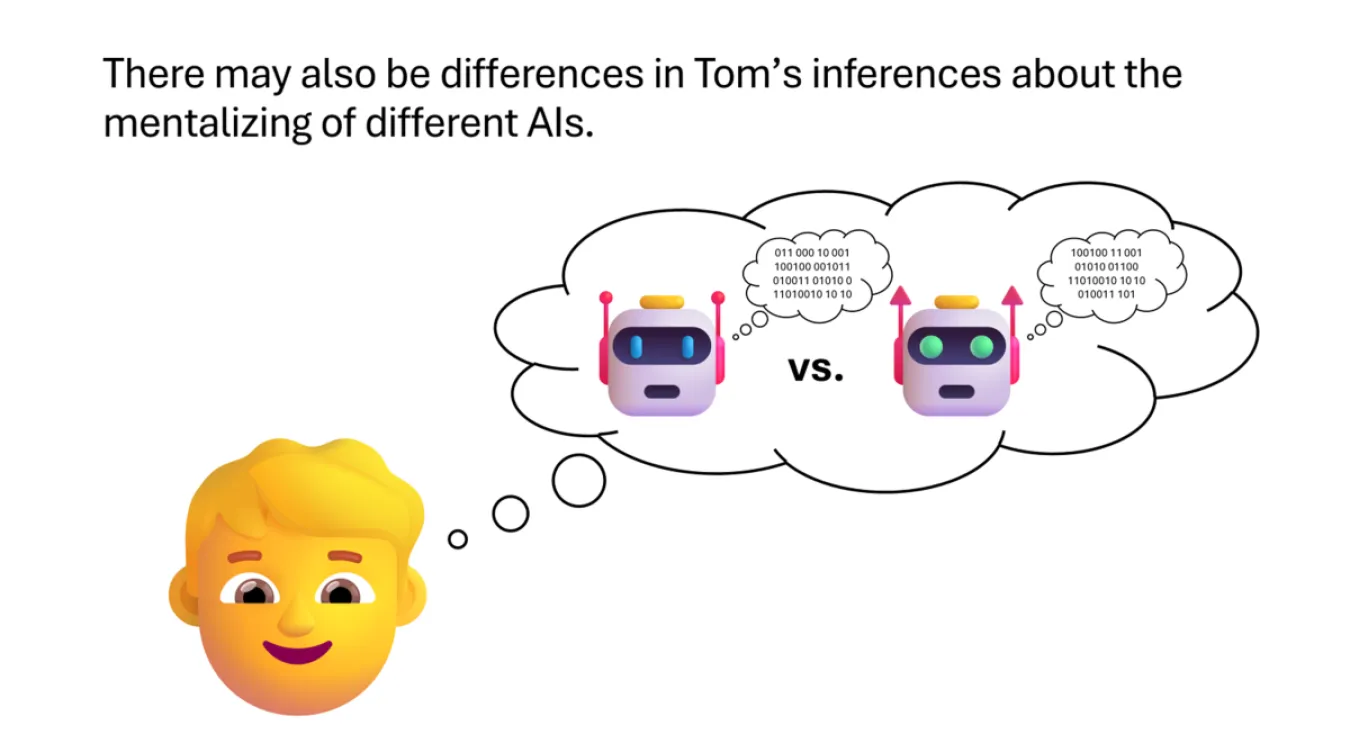
  • Cartoon of boy with speech ballon with 2 robots
    Magazine Issue
    08/2026 - SpeciaI issue on artificial intelligence

    How humans form beliefs about conversational AI

    • written by
    • Tobias R. Rebholz
    Why do we treat Alexa or ChatGPT like a helpful coworker – or even a friend? This article explores how talking to conversational AI shapes the beliefs we form about machines.
    Read more
  • In-Mind Blog

    Join the In-Mind team: Help us make psychology accessible to everyone!

    written by: Rinat Meerson, Stella Wernicke, Jana Dreston
  • Magazine Issue 09/2026

    Teamwork today and tomorrow: The skills that matter and how to build them

    written by: Lara Watermann, Natalie Hogh, Joshua Braun, Simone Kubowitsch
  • In-Mind Blog

    After "Adolescence": What we know (and don’t know) about gender attitudes and online misogyny

    written by: Kate Schramm, Silvana Weber
  • Magazine Issue 08/2026 - SpeciaI issue on artificial intelligence

    Benefits and risks of asking AI for health advice

    written by: Jaroslava Kaňková
  • Magazine Issue 04/2024

    Horoscopes – why we believe in them

    written by: Lea Sperlich
    When reading horoscopes, we often find sentences like: "Sometimes you are extroverted, sociable, and open-minded, sometimes rather introverted, skeptical, and reserved." If you feel that this statement applies to you... more
  • Magazine Issue 03/2024

    Context matters: Why women are not worse negotiators than men

    written by: Moritz Burmester, Yannik Escher, Danna Oomen, Hannes Petrowsky
    Mastering the art of negotiation is key to being successful in everyday life and in a highly competitive and dynamic professional world. One widespread belief among laypeople is that women... more
  • Magazine Issue 02/2024

    Is there an art center in our brain? That’s bananas!

    written by: Sophie G. Elschner
    Artworks can move us deeply. But does that mean our brain treats them in a special way? We can find out by looking at how the brain processes art and... more
  • Magazine Issue 02/2024

    That's cringe! – Wait a minute. What is cringe?

    written by: Thomas Feiler, Fabian Hutmacher
    The word “cringe” is on everyone's lips. What does it mean? How can it be described? An attempt to explain the phenomenon using established psychological constructs. more
  • Magazine Issue 06/2023

    Learning styles: Why they don't exist but still persist

    written by: Martin Daumiller, Benedikt Wisniewski
    It is a common myth that for optimal learning, individual learning styles should be identified and specifically supported. This might include identifying someone as a visual learner and designing the... more
  • Magazine Issue 12/2021

    Are victim or eyewitness statements credible? Several ways to check them

    written by: Nurul Arbiyah, Henry Otgaar, Eric Rassin
    In 2014, two teachers and six janitors were accused of child sexual abuse at Indonesia's Jakarta International School (JIS). Three preschool children reported that they had been repeatedly sexually abused... more
  • Load More Issues

In-Mind Blog

  • 16.12.2014 | Solid Science

    Solid science: How graduate students foster research transparency

    written by: Nicole Janz
    Reproducibility is seen as the gold standard for solid science. However, three are few incentive to work transparently, and even less incentives to conduct replication studies. To change this, more and more teachers are assigning replication studies to graduate students as a class assignment. Will this turn early career researchers into witch hunters? more
  • 05.12.2014 | Happiness & Well-being

    Becoming superhuman: Is it all in your mind?

    written by: Mallika Sarma, Cathleen Clerkin
    Everyone loves a good comic book hero, but what if superhuman feats were something you could learn to do in real life?  In this post, we will share some recent scientific evidence that suggests that through mindfulness, people can learn to control their minds, bodies, pain tolerance and emotions in ways that seem almost superhuman. more
  • 02.12.2014 | Social Influence & Negotiations

    Who gives a Tweet? Fandom, social identity, and why people take to Twitter

    written by: Jessica Tomory
    When we think of the world in terms of categories and different groups of people, we think of the various groups to which we belong and our identities within such groups.  The groups to which we belong impact how we perceive ourselves, how others perceive us, and the extent to which we express our social identities in order to bolster our self-esteem. This blog will examine how and why people are motivated to express their social identities using social media and, more specifically, will propose that Twitter serves an important identity function for group members. more
  • 15.11.2014 | Social Influence & Negotiations

    Is social psychology ready for the big science revolution?

    written by: Frank Bosco
    In this blog post, I will describe perhaps the greatest challenge facing social psychology (and other social sciences) in the coming decades: The curation and increased accessibility of research findings. I describe several big science efforts that lead to an eventual goal – a search engine of research findings capable of producing instant empirical summaries and translating findings using lay terms. more
  • 13.11.2014 | Meaning Making

    Hot or cold morality? (Part 1)

    written by: Andrew Monroe
    How do we make moral judgments?  Are people cold, calculating Vulcans? Or are they affectively hot hedonists? Researchers often present morality as a war between vying ‘hot’ and ‘cold’ processes, but in this two-part blog post I argue that the distinction is a false choice. Morality is both hot and cold, but not in the way previous research leads people to believe. more
  • 12.11.2014 | Culture

    Sorry, the relationship with your mother still matters for your achievement in life

    written by: Marieke van Egmond
    Play dates or homework? Piano lessons or TV? Mothers generally want the best for their children. However, what is ‘the best’? Happiness or academic achievement? And, how should parents go about raising their children in the ‘best’ way possible? One answer to this question is to be a ‘tiger parent’. This rather harsh ‘Chinese’ parenting style has been advocated to guarantee successful children. In this post, I will discuss if this means that all mothers should become a bit more ferocious when it comes to parenting. more
  • Load more blog posts

Editors' Choice

  • Magazine Issue 09/2026

    Teamwork today and tomorrow: The skills that matter and how to build them

    written by: Lara Watermann, Natalie Hogh, Joshua Braun, Simone Kubowitsch
  • In-Mind Blog
    a boy sitting next to a laptop using his phone

    After "Adolescence": What we know (and don’t know) about gender attitudes and online misogyny

    written by: Kate Schramm, Silvana Weber
  • Magazine Issue 08/2026 - SpeciaI issue on artificial intelligence
    Man using ChatGPT

    Benefits and risks of asking AI for health advice

    written by: Jaroslava Kaňková

Most Read

  • Magazine Issue 02/2014

    The good, the bad, and the ugly of the Dove Campaign for Real Beauty

    written by: Angela Celebre, Ashley Waggoner Denton
  • Magazine Issue 03/2026

    Children in front of a screen: what is the impact of technology on their development?

    written by: Marica Notte, Daniela Renzi
  • Magazine Issue 09/2025

    Viral and harmful: Violence in media and its impact on empathy

    written by: Mira Fauth-Bühler

The Inquisitive Mind is supported by:

  • DGPs – Deutsche Gesellschaft für Psychologie
  • C-SEB – Center for Social and Economic Behavior

Menu

  • Magazine
  • Blog
  • Submit to In-Mind
  • About In-Mind
  • Search
  • LinkedIn
  • Bluesky
  • Instagram
  • Print
  • RSS Feed
  • Cookie settings

About Us

In-Mind is a voluntary science communication project. We enable scientifically working psychologists to present their research topics in a scientifically sound, understandable and entertaining way for an interested audience: Psychology by scientists for everyone....more

Footer menu

  • Imprint
  • Data Protection