
Honor and Emotion
keywords:
culture / emotion / family honor / morality
Honor and Emotion
This paper discusses honor and its effects on emotion. The paper is divided into two parts. In the first part, the definition of honor is discussed. This section answers the questions ‘what is honor,’ and ‘are there different types of honor?’ Later, there is an overview on the ways in which honor influences emotional experiences and expressions. Throughout the paper, conclusions are reached based on honor and emotion research in Mediterranean, Northern European, North American and Middle-Eastern cultures. Imagine as... / more
Honor in the Past: The Case of Mexico

Honor in the Past: The Case of Mexico
Although at times honor is associated with bygone eras, lately it has also been very much in the news. Headlines scream when husbands, fathers, or even brothers, kill their female relatives for breaking their honor code. The logic behind these heinous acts is often related to disobedience of moral strictures such as staying out, associating with male non-relatives, wearing makeup or marrying without permission. / more
The dish on gossip: Its origins, functions, and bad reputation

keywords:
bad reputation / benefits / connectedness / evolution / gossip
The dish on gossip: Its origins, functions, and bad reputation
Gossip is ubiquitous – chances are that you have shared, heard, or been the topic of gossip today. Why do we love to talk about other people? Is gossiping part of our human nature? Are there benefits of gossip, to either the individual or to society? In this article I will review what researchers have learned about the nature of ... / more
It’s your choice! – Or is it really?
keywords:
change blindness / choice blindness / decision making / eyewitnesses
It’s your choice! – Or is it really?
For most of us it is difficult to imagine that we could decide to buy a v-neck sweater and end up with round-neck collar without even noticing the difference. If this happened in a wide variety of situations, it would mean that we are often not fully aware of the decisions we make. According to researchers studying a phenomenon called choice blindness, this is precisely the case. Numerous studies have shown that we often fail to... / more
When the thought of yourself nags you: How failure to attain cultural standards brings suicide on the fringe of consciousness
keywords:
escape / failure / self-awareness / standards / suicide-related thought accessibility
When the thought of yourself nags you: How failure to attain cultural standards brings suicide on the fringe of consciousness
On September 9, 2009, Dr. Sapandeep Sahni hanged herself after her pregnancy test came out negative for the fourth time. She had a daughter, but she and her family desired for her to have a son. It was culturally important. Otherwise, Dr. Sahni’s life could be seen as a success: she held a relatively prestigious job (a general practitioner), was planning to become an eye specialist, was popular with colleagues and patients alike, and was well off, living in a... / more
“Look in my eyes. I said in my eyes!”: Antecedents and Consequences of (Self-) Objectification
keywords:
objectification / objectifying gaze / self-objectification / social perception
“Look in my eyes. I said in my eyes!”: Antecedents and Consequences of (Self-) Objectification
Physical appearance is one of the primary cues for individuals living in a society guided by a vast “sexual market” (Baumeister & Vohs, 2004). Physical appearance also influences people’s achievements in areas that are not directly related to the sexual domain, such as their career (e.g., Register & Williams, 1990) or their educational success (e.g., Crandall, 1991, 1995). / more
Would you recognize the perpetrator? What do you need to know when you have to make an identification from a lineup?
keywords:
lineups / police practice / positive legal psychology / system variables
Would you recognize the perpetrator? What do you need to know when you have to make an identification from a lineup?
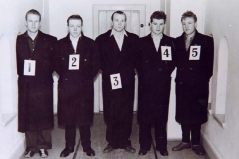
Would you be able to pick out the right person from a lineup? We discuss the role of various factors that can influence the decision-making process of eyewitnesses during the lineup procedures. / more
Death and deities: A social cognitive perspective
keywords:
immortality / religion / terror management theory
Death and deities: A social cognitive perspective
The universality of religious belief—in supernatural agents: gods, ghosts, souls, spirits, and their ilk—is, no doubt, the product of a whole host of interacting causal factors. However, the notion that such beliefs are driven by fear of death recurs throughout intellectual history. Although recent social psychological research provides some support for this claim, the relationship between mortality-related concerns and religious belief becomes clearer in light of so-called “dual-process models”, which allow for both conscious and unconscious... / more
The victim wars: How competitive victimhood stymies reconciliation between conflicting groups
The victim wars: How competitive victimhood stymies reconciliation between conflicting groups
Ask an Israeli about the conflict with Palestinians and you'll probably hear a tale of woe and victimhood. The strange thing is, if you ask a Palestinian the same question, you'll most likely hear the same story. Since Israel became a nation in 1948, both Israelis and Palestinians have felt victimized. / more
When does revenge taste sweet? A short tale of revenge
keywords:
justice / punishment / retribution / revenge
When does revenge taste sweet? A short tale of revenge
 Most everyone is familiar with the saying “revenge tastes sweet”, but is there some truth in this? It is only recently that revenge, and the psychological and behavioral implications, have received any empirical attention. The aim of the present article is to provide an overview on the issue of revenge from a scientific perspective and to gain insight into the potential “functionality” that acts of ... / more