  • EN
  • DE
  • FR
  • IT
  • NL

User account menu

  • Log in
Home
  • Magazine
    • All issues
    • Glossary
  • Blog
    • All blog posts
  • Submit to In-Mind
    • Articles
    • Blog posts
  • About In-Mind
    • Team
    • What is In-Mind?
    • Credits
  • Search

Psychology for You!

  • Magazine Issue
    09/2026

    Teamwork today and tomorrow: The skills that matter and how to build them

    • written by
    • Lara Watermann,
    • Natalie Hogh,
    • Joshua Braun,
    • Simone Kubowitsch
    Teams today collaborate across screens, time zones, and digital tools, but better technology does not always mean better teamwork. Hybrid meetings, information overload, and workflows supported by artificial intelligence (AI) create new challenges. Drawing on expert insights and psychological research, this article explores which team skills matter most and how teams can build them.

    Read more
  • AI-generated content may reflect gender stereotypes
    Magazine Issue
    08/2026 - SpeciaI issue on artificial intelligence

    Blaming the biased bot? Gender bias in AI-generated content

    • written by
    • Alexandra Wölfle
    With the growing popularity and increasing capabilities of generative AI, more and more attention is also drawn to AI model biases, in particular, gender biases. But what exactly does bias mean in this context, how should it be addressed, and what role do humans play in all this?
    Read more
  • What AIs are made of
    Magazine Issue
    08/2026 - SpeciaI issue on artificial intelligence

    Does ChatGPT think like humans?

    • written by
    • Jannis Friedrich
    AIs like ChatGPT are trained only on texts and do not actually experience the world. It’s been argued that for this reason, AI’s cannot really ‘understand’. This is called the symbol grounding problem: symbols have to be connected to perception and action. To address the question whether AIs can think like humans, this article looks at research on cognition and language.
    Read more
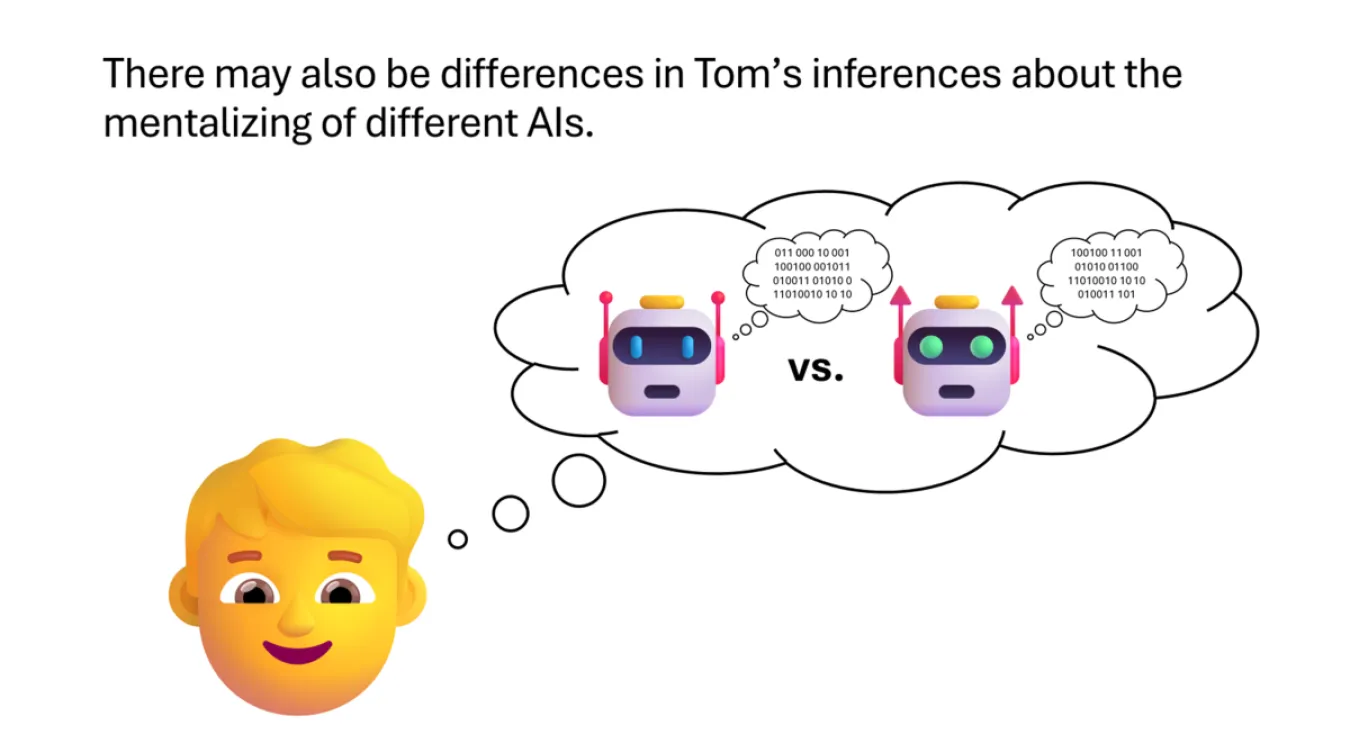
  • Cartoon of boy with speech ballon with 2 robots
    Magazine Issue
    08/2026 - SpeciaI issue on artificial intelligence

    How humans form beliefs about conversational AI

    • written by
    • Tobias R. Rebholz
    Why do we treat Alexa or ChatGPT like a helpful coworker – or even a friend? This article explores how talking to conversational AI shapes the beliefs we form about machines.
    Read more
  • In-Mind Blog

    Join the In-Mind team: Help us make psychology accessible to everyone!

    written by: Rinat Meerson, Stella Wernicke, Jana Dreston
  • Magazine Issue 09/2026

    Teamwork today and tomorrow: The skills that matter and how to build them

    written by: Lara Watermann, Natalie Hogh, Joshua Braun, Simone Kubowitsch
  • In-Mind Blog

    After "Adolescence": What we know (and don’t know) about gender attitudes and online misogyny

    written by: Kate Schramm, Silvana Weber
  • Magazine Issue 08/2026 - SpeciaI issue on artificial intelligence

    Benefits and risks of asking AI for health advice

    written by: Jaroslava Kaňková
  • Magazine Issue 03/2025

    Left-wing vs. right-wing: who is more likely to help others?

    written by: Bernhard Schubach
    Are supporters of the political left more prosocial and altruistic than their right-wing counterparts? In theory, this link is very plausible. This article summarizes the empirical research on the link... more
  • Magazine Issue 03/2025

    Small screens, big effects: How screen media shapes early childhood

    written by: Dr. Gizem Samdan
    How does early screen use shape child development? This article reveals how content type, family background, and parental media habits can either support or hinder a child’s cognitive, emotional, and... more
  • Magazine Issue 03/2025

    If you read this…

    written by: Mareike Ehlert, Elmar Souvignier
    … you can already do a lot! Reading is a bit like magic: You can easily read a word like “dozibrofu” out loud, even though you’ve probably never seen it... more
  • Magazine Issue 03/2025

    Turning disagreements into opportunities: How couples can grow through constructive communication

    written by: Lukas Repnik, Barbara Hadolt
    What if every argument could bring new understanding and growth in your relationship? Explore how conflicts, when handled constructively, can strengthen your bond. Backed by research and filled with actionable... more
  • Magazine Issue 02/2025

    The price is right: how to get the best possible outcome in price negotiations

    written by: Marco Warsitzka, Michel Mann, Marco Schauer, Roman Trötschel
    Not every negotiation offers the possibility for win-win agreements. In simple price negotiations, one party’s loss implies an equal gain for the other party. This article outlines tactics and strategies... more
  • Magazine Issue 02/2025

    The psychology behind being a dad and its effects on fathers themselves

    written by: Gustaf Glavå
    Becoming a father for one’s own psychological development? While this might sound self-centered, research indicates that pursuing fatherhood offers psychological benefits not only for fathers themselves but, more importantly, for... more
  • Load More Issues

In-Mind Blog

  • 09.09.2018 | Generalist Grab Bag

    How to get into shape like the Hulk

    written by: Anneloes Kip, Marleen Gillebaart
    Do you want to get into shape but find it hard to carry out your good intentions? The Hulk can help you! more
  • 25.07.2018 |

    Call for Blogs and Bloggers

    written by: Amanda Sesko, Mitch Brown
    We invite you to submit a blog (1,000 words or less) for In-Mind Magazine, the flagship online journal of the In-Mind Foundation. In-Mind Magazine is a peer-reviewed online journal that... more
  • 30.06.2018 | Big Questions in Society, Current Events, Violence & Aggression

    Doing ill for ‘the greater good’: Understanding what really went on in the Stanford Prison Experiment

    written by: Alex Haslam, Stephen Reicher, Jay Van Bavel
    Just about every highschool and college psychology textbook offers extensive coverage of Zimbardo’s Stanford Prison Experiment (SPE). The meaning of the SPE seemed obvious — that when given roles with power, people naturally become brutal tyrants. This message has had lasting influence, not only in psychology but in the world at large. However, after researchers have recently gained access to the SPE archives, it has come to light that much of what we thought we knew about the study is inaccurate. We asked three experts to weigh in on these recent events, and the resulting discussion is one that offers valuable insights not only into the SPE but also into the role of debate in science and way that we engage with, and teach about, psychology’s classic studies. more
  • 29.06.2018 | Current Events, Solid Science

    Wait, What?! The Stanford Prison Experiment was pre-tested?

    written by: Job van Wolferen
    With the recent news regarding the questionable nature of the infamous Stanford Prison Experiment, we thought it was purdent to republish one of our earlier blog articles drawing attention to the issue. The piece below appeared on our blog in 2012. more
  • 24.06.2018 | Big Questions in Society, Current Events

    The Violence We Have Committed

    written by: James Coan
    Circle of Willis is a podcast series from Associate Professor and Clinical Psychologist Dr. James Coan. The podcast features interviews with many of today's top social scientists, journalists, authors, and more. In a recent special episode of Circle of Willis, Dr. Coan speaks with five developmental scientists about what may be happening to the children who are currently being separated from their parents as part of a policy to deter immigration and asylum seekers at the southern border to the United States. Dr. Coan offers some background to the problem, what science has to say about it, and a link to the podcast below. more
  • 20.05.2018 | Demystifying Mental Health

    Chemical or Financial Imbalances? Mental Health, Income Inequality & American Culture

    written by: Andrew Archer
    As societies become more unequal, the prevalence of all forms of mental illness increase—in part—due to the perception of extreme differences in status. The rise of mood disorders is caused by our social immersion in a digital culture—built and shaped via individualistic values—which is the financial machine for perpetuating income inequality. more
  • Load more blog posts

Editors' Choice

  • Magazine Issue 09/2026

    Teamwork today and tomorrow: The skills that matter and how to build them

    written by: Lara Watermann, Natalie Hogh, Joshua Braun, Simone Kubowitsch
  • In-Mind Blog
    a boy sitting next to a laptop using his phone

    After "Adolescence": What we know (and don’t know) about gender attitudes and online misogyny

    written by: Kate Schramm, Silvana Weber
  • Magazine Issue 08/2026 - SpeciaI issue on artificial intelligence
    Man using ChatGPT

    Benefits and risks of asking AI for health advice

    written by: Jaroslava Kaňková

Most Read

  • Magazine Issue 02/2014

    The good, the bad, and the ugly of the Dove Campaign for Real Beauty

    written by: Angela Celebre, Ashley Waggoner Denton
  • Magazine Issue 03/2026

    Children in front of a screen: what is the impact of technology on their development?

    written by: Marica Notte, Daniela Renzi
  • Magazine Issue 09/2025

    Viral and harmful: Violence in media and its impact on empathy

    written by: Mira Fauth-Bühler

The Inquisitive Mind is supported by:

  • DGPs – Deutsche Gesellschaft für Psychologie
  • C-SEB – Center for Social and Economic Behavior

Menu

  • Magazine
  • Blog
  • Submit to In-Mind
  • About In-Mind
  • Search
  • LinkedIn
  • Bluesky
  • Instagram
  • Print
  • RSS Feed
  • Cookie settings

About Us

In-Mind is a voluntary science communication project. We enable scientifically working psychologists to present their research topics in a scientifically sound, understandable and entertaining way for an interested audience: Psychology by scientists for everyone....more

Footer menu

  • Imprint
  • Data Protection