  • EN
  • DE
  • FR
  • IT
  • NL

User account menu

  • Log in
Home
  • Magazine
    • All issues
    • Glossary
  • Blog
    • All blog posts
  • Submit to In-Mind
    • Articles
    • Blog posts
  • About In-Mind
    • Team
    • What is In-Mind?
    • Credits
  • Search

Psychology for You!

  • Magazine Issue
    09/2026

    Teamwork today and tomorrow: The skills that matter and how to build them

    • written by
    • Lara Watermann,
    • Natalie Hogh,
    • Joshua Braun,
    • Simone Kubowitsch
    Teams today collaborate across screens, time zones, and digital tools, but better technology does not always mean better teamwork. Hybrid meetings, information overload, and workflows supported by artificial intelligence (AI) create new challenges. Drawing on expert insights and psychological research, this article explores which team skills matter most and how teams can build them.

    Read more
  • AI-generated content may reflect gender stereotypes
    Magazine Issue
    08/2026 - SpeciaI issue on artificial intelligence

    Blaming the biased bot? Gender bias in AI-generated content

    • written by
    • Alexandra Wölfle
    With the growing popularity and increasing capabilities of generative AI, more and more attention is also drawn to AI model biases, in particular, gender biases. But what exactly does bias mean in this context, how should it be addressed, and what role do humans play in all this?
    Read more
  • What AIs are made of
    Magazine Issue
    08/2026 - SpeciaI issue on artificial intelligence

    Does ChatGPT think like humans?

    • written by
    • Jannis Friedrich
    AIs like ChatGPT are trained only on texts and do not actually experience the world. It’s been argued that for this reason, AI’s cannot really ‘understand’. This is called the symbol grounding problem: symbols have to be connected to perception and action. To address the question whether AIs can think like humans, this article looks at research on cognition and language.
    Read more
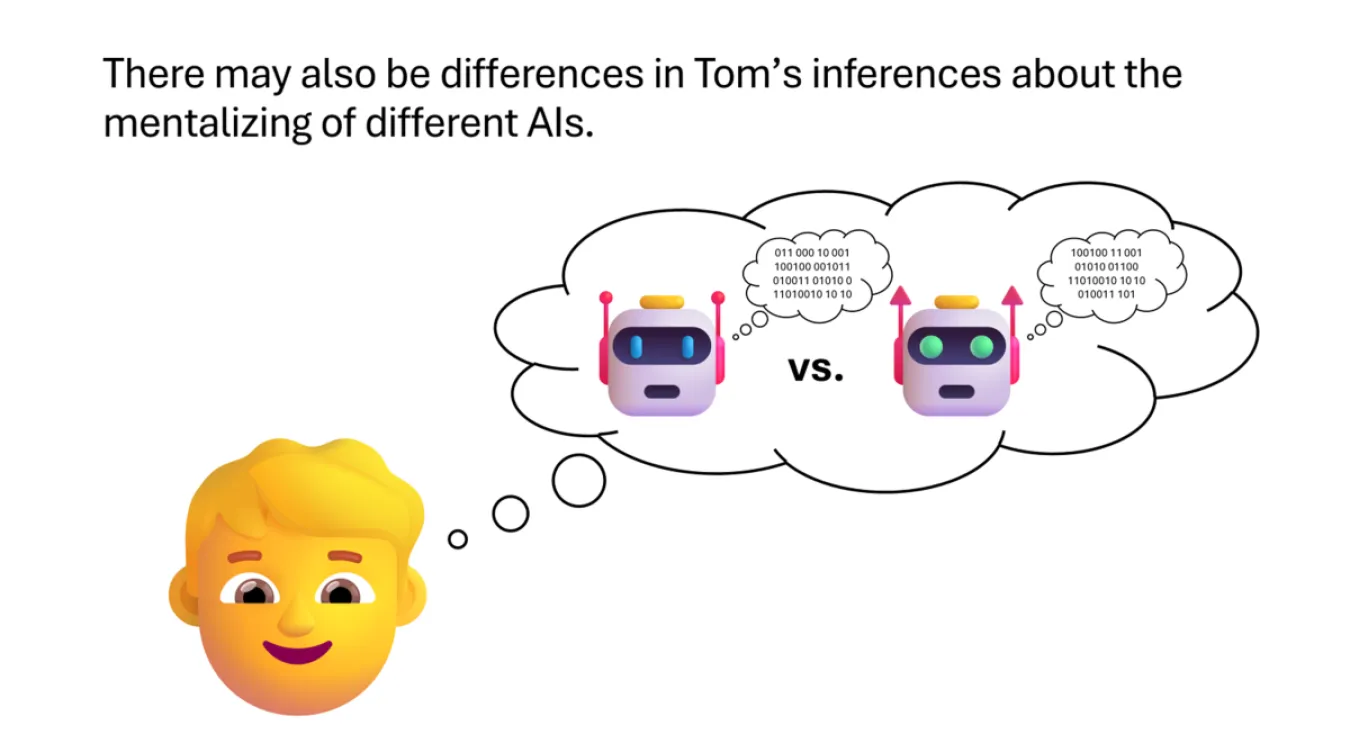
  • Cartoon of boy with speech ballon with 2 robots
    Magazine Issue
    08/2026 - SpeciaI issue on artificial intelligence

    How humans form beliefs about conversational AI

    • written by
    • Tobias R. Rebholz
    Why do we treat Alexa or ChatGPT like a helpful coworker – or even a friend? This article explores how talking to conversational AI shapes the beliefs we form about machines.
    Read more
  • In-Mind Blog

    Join the In-Mind team: Help us make psychology accessible to everyone!

    written by: Rinat Meerson, Stella Wernicke, Jana Dreston
  • Magazine Issue 09/2026

    Teamwork today and tomorrow: The skills that matter and how to build them

    written by: Lara Watermann, Natalie Hogh, Joshua Braun, Simone Kubowitsch
  • In-Mind Blog

    After "Adolescence": What we know (and don’t know) about gender attitudes and online misogyny

    written by: Kate Schramm, Silvana Weber
  • Magazine Issue 08/2026 - SpeciaI issue on artificial intelligence

    Benefits and risks of asking AI for health advice

    written by: Jaroslava Kaňková
  • Magazine Issue 06/2024 - Special issue on sport psychology

    The role of others' presence in sport performance under pressure

    written by: Laura Chareyre, Sandrine Isoard-Gautheur, Damien Brevers, Aïna Chalabaev
    The presence of other people is inevitable in sport and dealing with it is crucial for high-level performance. This article presents the potential explanation of social inhibition or choking under... more
  • Magazine Issue 06/2024 - Special issue on sport psychology

    Thinking gold: the link between cognition and performance in olympic athletes

    written by: Laura Will, Hanna de Haan, Babett Lobinger, Charlotte Sanden, Markus Raab, Lisa Musculus
    In Olympic athletes, superior physical performance is clearly evident on observation. The non-visible cognitive processes also contribute to successful performance, yet they are still weakly researched and their mechanisms are... more
  • Magazine Issue 06/2024 - Special issue on sport psychology

    Sleep before, during and after the Olympic Games: an important determinant of sports performance

    written by: Kerstin Hoedlmoser, Patricia Frytz, Daniel Erlacher, Michele Lastella, Jacopo Vitale, Mathieu Nedelec
    This article focuses on the basics of normal sleep and the various sleep problems in competitive sports athletes. Strategies and tips for improving sleep behaviour of athletes before, during, and... more
  • Magazine Issue 06/2024 - Special issue on sport psychology

    Editorial: Mastering the Olympic Mind - The psychology behind peak sports performance

    written by: Lisa Musculus, Elisa Bisagno, Sylvain Laborde, Ruud den Hartigh
    In summer 2024 all eyes will be on the elite athletes performing at the Olympics. This international special issue delves into the secrets of elite sports performance and reveals how... more
  • Magazine Issue 06/2024 - Special issue on sport psychology

    Psychological aspects of elite performance in new Olympic disciplines: The case of climbing

    written by: Xavier Sanchez, Julian Henz, Cécile Martha, Jerry Prosper Medernach
    In recent years, sports that have traditionally been practiced as recreational and non-competitive have been added in the official Olympic program. For example, climbing is on the Olympic program for... more
  • Magazine Issue 06/2024 - Special issue on sport psychology

    Unlocking the power of sports: the impact of Olympic values in prison rehabilitation

    written by: Omar Zanna, Cendrine Mercier, Jean-Philippe Melchior
    Discover how sports in prison foster empathy, health, and social reintegration. By practicing with the Olympic Spirit, inmates find a means to reconnect and rebuild themselves. A holistic approach that... more
  • Load More Issues

In-Mind Blog

  • 11.10.2015 | Self-Control & Decision-Making

    What does your selfie say about you?

    written by: Lin Qiu
    Selfie is a new form of self-expression in this digital age. In this post, I will discuss our research on how selfies reveal the personality of their owners and how people judge others’ personality based on selfies (Qiu, Lu, Qu, & Zhu, 2015). more
  • 31.08.2015 | Culture

    Bicultural minds: How capable are you in responding culturally appropriate?

    written by: Katerina Pouilasi
    When individuals live actively with two cultures (in families, organizations or society at large) they, partly unconsciously, partly deliberately, may change towards acquiring a ‘bicultural mind’. I will discuss here whether these individuals are capable of spontaneously producing appropriate responses that fit the expectation patterns of either of their two cultures. more
  • 21.08.2015 | Big Questions in Society, Current Events, Gender

    Why gender neutral toy aisles might help children’s development stay on target

    written by: Cathleen Clerkin
    In this blog post I will discuss how Target’s recent decision to do away with gender specific toy aisles could actually help children develop new cognitive skills, and as well as increase their willingness to play with different types of toys. more
  • 01.08.2015 | Self-Control & Decision-Making

    Why do we still have a cognitive bias that makes us send innocent people to jail? – Explanations of the confirmation bias

    written by: Marly van Oirschot
    The confirmation bias – seeking and interpreting information to support your pre-existing beliefs – can have tremendous consequences. In this blog, I will explain the existence of the confirmation bias in the criminal justice system and give two possible explanations to why we still have this bias. more
  • 26.07.2015 | Political Psychology, Race & Ethnicity

    Does it matter if people are aware of their implicit racial bias?

    written by: Aaron Moss
    In this blog post, I discuss how people respond to information about their implicit racial bias—automatic attitudes and beliefs that favor one ethnic group over another. Although people can be defensive, emerging research suggests there are benefits to accepting implicit racial bias and being aware of this subtle prejudice. more
  • 01.07.2015 | Culture

    The cross-cultural psychology of Internet privacy concern

    written by: Robert Thomson
    In a recent cross-cultural study of Facebook users in Japan and the US, I show that Japanese SNS users are more concerned about Internet privacy than American SNS users. And it turns out that because Americans have higher general trust, they less likely to believe that a stranger would take advantage of their private information, should it be leaked online. more
  • Load more blog posts

Editors' Choice

  • Magazine Issue 09/2026

    Teamwork today and tomorrow: The skills that matter and how to build them

    written by: Lara Watermann, Natalie Hogh, Joshua Braun, Simone Kubowitsch
  • In-Mind Blog
    a boy sitting next to a laptop using his phone

    After "Adolescence": What we know (and don’t know) about gender attitudes and online misogyny

    written by: Kate Schramm, Silvana Weber
  • Magazine Issue 08/2026 - SpeciaI issue on artificial intelligence
    Man using ChatGPT

    Benefits and risks of asking AI for health advice

    written by: Jaroslava Kaňková

Most Read

  • Magazine Issue 02/2014

    The good, the bad, and the ugly of the Dove Campaign for Real Beauty

    written by: Angela Celebre, Ashley Waggoner Denton
  • Magazine Issue 03/2026

    Children in front of a screen: what is the impact of technology on their development?

    written by: Marica Notte, Daniela Renzi
  • Magazine Issue 09/2025

    Viral and harmful: Violence in media and its impact on empathy

    written by: Mira Fauth-Bühler

The Inquisitive Mind is supported by:

  • DGPs – Deutsche Gesellschaft für Psychologie
  • C-SEB – Center for Social and Economic Behavior

Menu

  • Magazine
  • Blog
  • Submit to In-Mind
  • About In-Mind
  • Search
  • LinkedIn
  • Bluesky
  • Instagram
  • Print
  • RSS Feed
  • Cookie settings

About Us

In-Mind is a voluntary science communication project. We enable scientifically working psychologists to present their research topics in a scientifically sound, understandable and entertaining way for an interested audience: Psychology by scientists for everyone....more

Footer menu

  • Imprint
  • Data Protection